



We often talk about data visualization best practices, but it's just as helpful to share WORST practices once in a while too.
At Maven Analytics, we see lots of student dashboards, and the most common mistakes we see can be grouped into the following 6 categories:
1. Using the wrong type of chart
We see this one all the time, and it can take many forms.
Sometimes people will try to show categorical data with a line chart (which should be reserved to show trends over time).
Other times, we’ll see treemaps used where a bar chart would communicate the insight more effectively.
In the example below, you see a pie chart used to show quarterly data, which isn’t necessarily wrong, but which can be communicated more effectively with a column or line chart:

2. Lack of focus
Another common mistake we see, especially among newer data storytellers, is including too much information and lacking focus in their visuals.
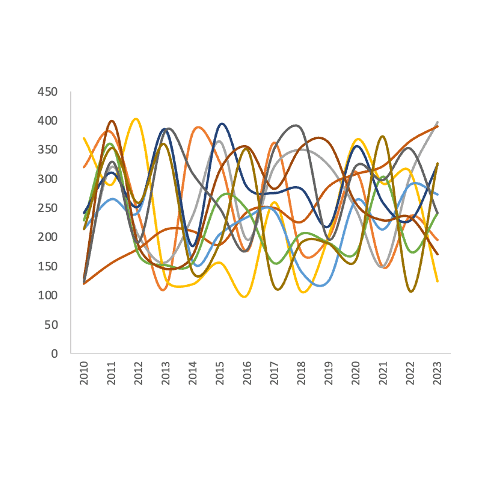
In the example below, we see the chart on the left with too much going on. It just looks like spaghetti, and doesn’t help communicate the pattern or serve any clear purpose.
In cases like these, you can either remove series that don’t contribute to the analysis, or use selective color that draw attention to the data points that matter most, as shown on the right.

3. Noise and Distractions
As a general principle, if it doesn’t add value, it doesn’t belong in the visual.
Some common distractions we see are 3D formats, animations, and complicated background images.
Just because a feature exists, doesn’t mean you have to use it.
In many cases, when visualizing data, less is more. Keep it simple.
In the example below, on the left we have 3D effects, beveled edges, and exploding segments. It’s just over the top bad.
In this case, sticking with the simple donut chart on the right would do just fine and make your story easier to interpret.

4. Prioritizing Form Over Function
We see this one all the time in our data challenges. Essentially, prioritizing form over function means picking charts based on what looks cool, rather than what communicates the information most clearly.
In the example on the left, we see a sunburst chart, which looks pretty sweet, but is actually quite tough to interpret.
For something like this, you may not choose to visualize that data at all, if a simple table like the one on the right provides the exact information you need.

5. Misleading Narrative
Telling a misleading narrative is about exaggerating trends to appear more dramatic or significant than they really are.
The chart on the left makes the difference between male and female seem massive, because the Y axis has been truncated so much that it makes fractions of percentages look bigger than they are.
When we reset that Y axis to start from zero, we see the real story, which is that there is no significant difference at all.

6. Missing Context
The chart on the left is a dual axis chart, but it is impossible to tell what’s what. There is no chart title, no legend, no axis labels to help us match each series to the correct values.
The obvious fix here is to simply add those chart elements to make sure readers can follow along.

These are some of the most common data visualization mistakes we see.
If you can keep these in mind and avoid them, it will go a long way toward improving your data storytelling abilities and maximizing the impact you can drive for your organization.
If you enjoyed reading this, you might want to check out our brand new course, Data Literacy Foundations.
We’ve made it free through March 31st so you can take advantage of it even if you don’t have a paid subscription.
FREE COURSE: Data Literacy Foundations
https://mavenanalytics.io/course/data-literacy-foundations


Chris Dutton
Founder & CPO
Chris is an EdTech entrepreneur and best-selling Data Analytics instructor. As Founder and Chief Product Officer at Maven Analytics, his work has been featured by USA Today, Business Insider, Entrepreneur and the New York Times, reaching more than 1,000,000 students around the world.